Draper City Renewable Energy Resolution
DRAFT RESOLUTION NO. 19-##
A RESOLUTION ADOPTING A SUSTAINABLE ENERGY POLICY
WHEREAS, Draper City has approximately 47,000 residents located in the south eastern portion of Salt Lake County, an urbanized population center totaling approximately 1.15 Million residents; and
WHEREAS, the urbanization and geography of Salt Lake County result in periods of poor air quality and other environmental concerns due in large part to the use of fossil fuels; and
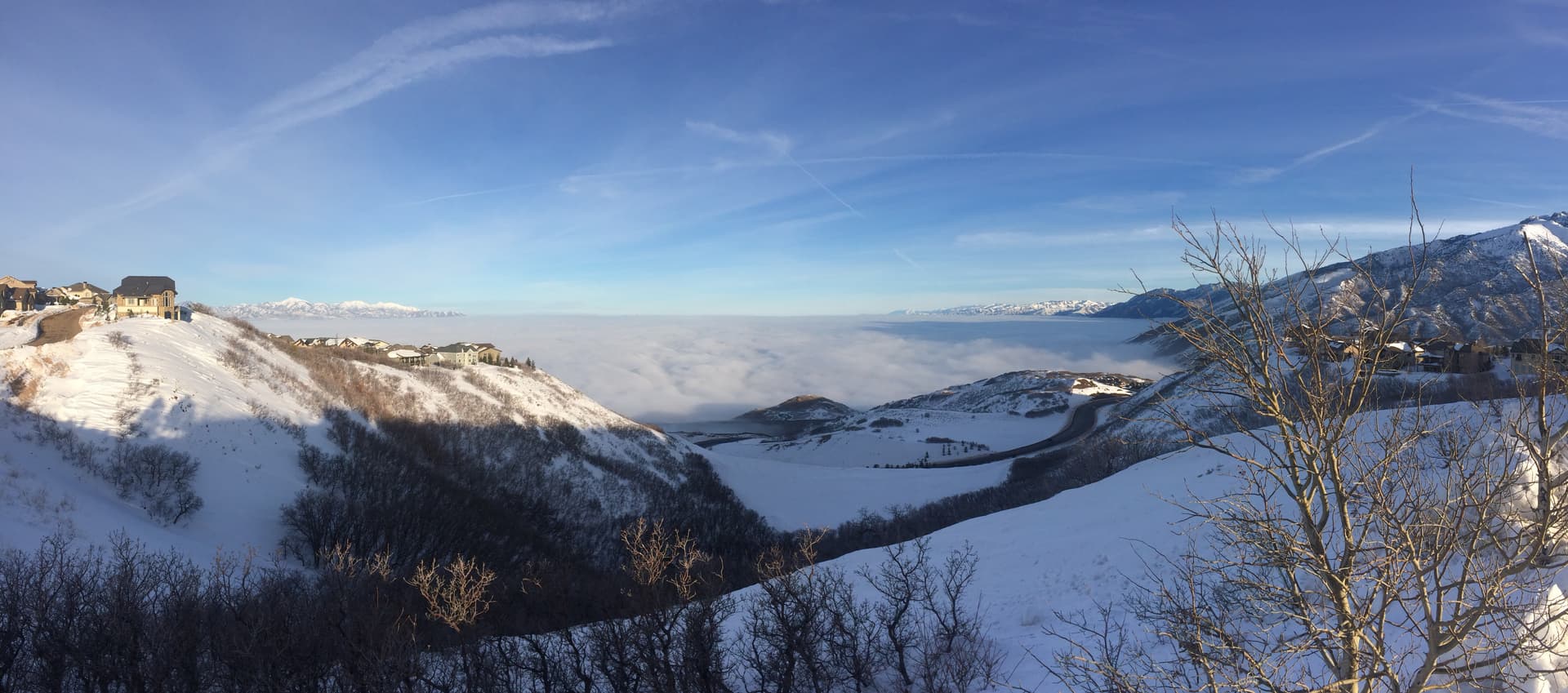
Dense Smog of Inversion from South Mountain. Draper, UT
WHEREAS, the residents and organizations of Utah emit 19 tCO2/resident/year, five times the median global emission of 3.8 tCO2/person/year; and
WHEREAS, the residents and organizations of Utah’s emissions from electric power alone is 8.8 tCO2/resident/year; and
WHEREAS, the energy from fossil fuel sources utilized by and within Draper City therefore disproportionately impacts public health, safety and welfare both locally and worldwide; and
WHEREAS, Draper City’s median household income is $94,800, sixty percent higher than the national median income, and so has a social responsibility, because of their socioeconomic status, to act to reduce emissions which disproportionately impact the less economically advantaged; and
WHEREAS, as determined by the scientific community, the social cost of carbon, an economic externality not captured in current $/kWh utility pricing which does not include the social cost of PM2.5 and other non-CO2 emissions, is currently over $40/tCO2 and rising — a true cost of over $350/resident/year not included in utility pricing; and
WHEREAS, historic Rocky Mountain Power renewable energy premiums indicate a current added-cost ceiling of $230 – $350/resident/year to source 100% of electricity from non-fossil fuel resources; and
WHEREAS, recent advances in the field of energy technology have made renewable energy more economically viable than in the past and, in some cases, more cost-effective than traditional energy sources even before factoring in the social cost of carbon, and the cost of renewable energy is expected to continue declining over the next decade; and
WHEREAS, the transition to a low-carbon community reliant on renewable energy resources will provide a range of benefits including improved air quality, enhanced public health, increased national and energy security, local jobs, reduced reliance on finite resources and myriad other positive outcomes; and
WHEREAS, many residents choose to live in Draper City because of its natural amenities including open space, mountain elevations, reliable water, and moderate climate, and value the support to our quality of life these natural amenities provide; and
WHEREAS, without bold action, global mean temperatures will rise to 3ºC (optimistic) or 4ºC (pessimistic) above pre-industrial levels by 2100; and
WHEREAS, global heating will reach 1.5°C between 2030 and 2052 if it continues to increase at the current rate, and climate-related impacts to natural and human systems are larger if global heating exceeds 1.5°C, including long-lasting or irreversible impacts, such as the loss of some ecosystems and wildlife extinction; and
WHEREAS, local governments are on the front line of climate crises, community-based efforts are nimble and able to address the impacts of climate crises, including drought, storms, heat-waves, wildfires, and watershed impacts; and
WHEREAS, in the February 13, 2019 National Parks, Forests and Public Lands subcommittee hearing, emphasizing “the power of local government in solving this problem,” Utah Congressional Representative Curtis said, “if you want to reduce [future heating] by two degrees, mayors know how to solve this”; and
WHEREAS, other Utah cities are currently renegotiating their agreements with Rocky Mountain Power; and
WHEREAS, the Draper City Council hereby finds this action to be in the best interest of public's health, safety and general welfare.
NOW, THEREFORE, BE IT RESOLVED BY THE CITY OF DRAPER, STATE OF UTAH AS FOLLOWS:
1. Renewable Energy Goals: 100% Renewable Electricity by 2030.
Draper City, in collaboration with Rocky Mountain Power, other Utah municipalities, and the State of Utah Public Service Commission as authorized in the Community Renewable Energy Act (HB 411), will achieve an amount equivalent to 100% of the annual electric energy supply for participating customers from a renewable energy resource by 2030. The City will also transition to 100% renewable energy for municipal operations by 2030.
2. Environmental Crises caused by anthropogenic global heating.
Recognizing the scientific consensus that local, regional, and global environmental crises caused by anthropogenic global heating are occurring and are increasing, as outlined in the IPCC Special Report on 1.5ºC Warming, the Fourth National Climate Assessment, and the IPBES Global Assessment Report on Biodiversity and Ecosystem Services, the Draper City Council encourages citizens, communities, and businesses to foster conversations about the local and collaborative actions required by individuals, businesses, and municipalities to limit the rise of global mean temperatures 1.5ºC above pre-industrial levels.